Calgary Neighbourhood Web Design Guide | DevGurux
Table of Contents
If your website only ever says “Calgary,” you’re competing with every other business in a city of over a million people. Most local businesses don’t actually compete city-wide — a Beltline café isn’t fighting for customers in Cranston, and a Kensington boutique doesn’t need to outrank a shop in Deer Ridge. They’re competing within a few kilometres, and “Calgary” as a keyword is far too broad to reflect that.
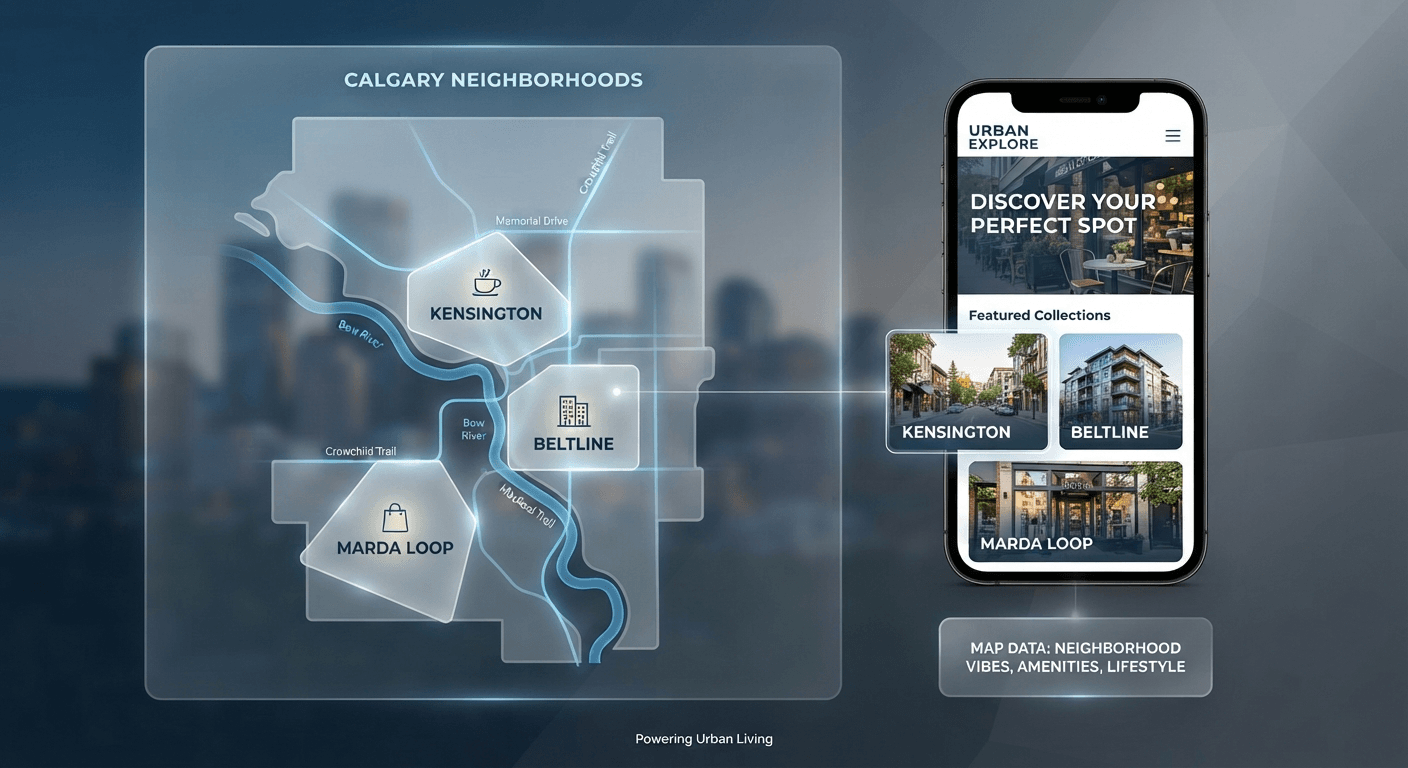
This is where neighbourhood-level web design and content make a real difference. Building a site — and writing content — around the specific community a business actually serves is one of the most underused local SEO levers in this city. This guide breaks down what that looks like in practice for three of Calgary’s most distinct commercial neighbourhoods: Beltline, Marda Loop, and Kensington, and how to build that structure into a website without turning it into keyword stuffing.
Why “Calgary” Is the Wrong Keyword for Most Local Businesses {#why-calgary-is-wrong}
Search intent for local services is almost always tied to proximity. Someone searching “physiotherapist Calgary” from their phone in Marda Loop is functionally asking “physiotherapist near me” — Google already knows this and adjusts results based on location, even when the searcher only typed the city name.
The problem is that most Calgary business websites only ever mention the city, not the neighbourhood, in their content. That means the site is relying entirely on Google Business Profile signals and IP-based location matching to do the local-relevance work — when the website itself could be reinforcing it directly.
Did You Know? Google’s local ranking system weighs relevance, distance, and prominence together. A website that explicitly, naturally mentions the neighbourhood it serves gives Google a stronger relevance signal than one that only states “Calgary, AB” in the footer.
This doesn’t mean stuffing “Beltline” into every sentence — it means writing genuinely useful, neighbourhood-specific content that a search engine (and a real visitor) can tell was written by someone who actually knows the area.
Beltline: Website Considerations for a Dense, Fast-Moving Core
Beltline is Calgary’s densest neighbourhood — high foot traffic, a mix of condos and offices, and a customer base that’s overwhelmingly mobile-first. People here search on their phones, standing on 17th Ave or waiting for the C-Train, and they expect an answer in seconds.
What this means for a Beltline business website:
- Speed is non-negotiable. A slow-loading site loses a Beltline visitor faster than almost anywhere else in the city, simply because of how much of the traffic is on-the-go mobile searches.
- Parking and transit information matters more here than in most neighbourhoods. If you have a Beltline business, stating clearly whether there’s parking, or how close you are to the C-Train, removes a real point of friction.
- 17th Ave-specific content performs well for businesses on or near that strip — mentioning it by name in your service or about page is more useful than a generic “in the heart of Calgary” line.
Marda Loop: Website Considerations for a Walkable Community Strip
Marda Loop has a distinctly local, walkable-strip identity — independent boutiques, cafés, and service businesses along a compact commercial stretch, with a customer base that skews toward people who already live in or near the community and are choosing between a handful of familiar options.
What this means for a Marda Loop business website:
- Community trust signals carry more weight than in denser areas. Reviews, “locally owned” framing, and mentions of how long you’ve served the Marda Loop community all matter more here than generic credentials.
- Cross-linking to nearby Marda Loop businesses or community associations (where genuinely relevant, e.g. a co-marketing relationship) can reinforce local relevance — but only where it’s a real relationship, not a forced link.
- Content that reflects the walkable, community feel — mentioning nearby landmarks or the general character of the strip — tends to read as more authentic than corporate-sounding city-wide copy.
Kensington: Website Considerations for a Boutique, Character-Driven District
Kensington trades on character — independent, slightly eclectic, historically distinct from big-box retail. Businesses here are usually selling an experience or a point of view, not just a commodity service, and the website needs to reflect that rather than defaulting to a generic small-business template.
What this means for a Kensington business website:
- Visual and brand personality matter more here than in most neighbourhoods. A template that looks identical to a suburban strip-mall business undersells a Kensington brand.
- Storytelling content performs well — an “About” page that actually explains the business’s history or philosophy fits Kensington’s character-driven audience better than a generic services list.
- Foot-traffic-driven businesses benefit from clear, prominent hours and a strong “Visit Us” section, since a large share of Kensington’s customer base is browsing the district in person before or after finding a business online.
The Framework: How Neighbourhood Content Should Actually Work
Neighbourhood SEO content works when it follows a simple rule: it has to be true and specific, not just inserted.
- Pick the neighbourhood(s) you actually, genuinely serve — not every neighbourhood in the city. A locksmith might legitimately serve all of Calgary; a café does not.
- Write real, distinct content for each one — not the same paragraph with the neighbourhood name swapped out. Google’s helpful content systems are specifically built to catch this pattern, and it reads as low-value to human visitors too.
- Reference genuinely local details — nearby landmarks, the general character of the area, transit or parking realities — details that couldn’t be copy-pasted onto a page about a different city entirely.
- Keep NAP (name, address, phone) consistent across the website, Google Business Profile, and any neighbourhood or community association directories you’re listed in.
- Link these neighbourhood pages back to your core service page, so the authority they build flows toward the page that actually needs to rank for your primary commercial keyword — for most Calgary businesses I work with, that’s a page like Calgary web development services.
Pro Tip: If you only serve one or two neighbourhoods with real depth, don’t dilute that by creating thin pages for six more just to “cover more ground.” Three genuinely strong neighbourhood pages outperform ten shallow ones, both for rankings and for how a real visitor perceives your credibility.
Where Neighbourhood Targeting Goes Wrong
- Doorway pages. Creating a near-identical page for every Calgary neighbourhood with only the name swapped is a well-documented pattern Google’s systems are built to detect and devalue — it can drag down the whole site’s quality signal, not just those pages.
- Claiming neighbourhoods you don’t serve. If your FAQ or content mentions Beltline, Marda Loop, and Kensington but your actual client base and case studies are elsewhere, that’s a trust problem the moment a visitor checks.
- Neighbourhood mentions with no supporting content. A single sentence naming three neighbourhoods in an FAQ answer is a start, but it’s not the same as actually having content, internal links, or case studies that back it up.
- Inconsistent NAP across directories. A different address format or phone number on a neighbourhood business association listing versus your website confuses both users and Google’s local matching.
Neighbourhood vs. City-Wide Targeting: Comparison
| Factor | City-Wide Only (“Calgary”) | Neighbourhood-Specific (Beltline, Marda Loop, Kensington) |
|---|---|---|
| Competition level | High — every Calgary business in your category | Lower — narrower, more winnable field |
| Search relevance signal | Weak, generic | Strong, specific |
| Content authenticity | Easy to sound generic | Easier to sound genuinely local |
| Best for | City-wide or delivery-based services | Storefront, walk-in, or service-area businesses tied to a specific community |
| Risk if done poorly | Low (nothing to overclaim) | High if pages are thin or claims aren’t backed by real service |
Neighbourhood targeting isn’t a replacement for city-wide content — it’s an additional layer that works best stacked on top of a strong core service page, not instead of one.
How I Build Neighbourhood Structure Into a Calgary Website
- Confirm the actual service area — which neighbourhoods a business genuinely serves, based on where existing clients and foot traffic actually come from.
- Map the core service page and its supporting neighbourhood content — the goal is always to strengthen one clear flagship page like my Calgary web development page, not to split attention evenly across a dozen thin pages.
- Write distinct, specific content per neighbourhood — real detail, not templated variables.
- Align schema and Google Business Profile to match the neighbourhood claims made on-site.
- Track which neighbourhood terms actually bring in traffic and inquiries, and expand only where there’s genuine demand.
This is the same structural thinking behind everything I build — see the full Calgary web development process or get a starting estimate if you’re weighing a rebuild that includes this kind of local structure.
FAQ
Does mentioning my neighbourhood on my website actually help me rank higher? Yes, when it’s genuine and specific. It reinforces the relevance signal Google’s local algorithm already considers, on top of your Google Business Profile — but only if the content is real, not a copy-pasted template with the name swapped.
Should I target every Calgary neighbourhood I could theoretically serve? No. Fewer, deeper neighbourhood pages consistently outperform many thin ones — both for search rankings and for how credible the content looks to an actual visitor.
What’s the difference between Beltline, Marda Loop, and Kensington for a business website? Each has a distinct customer behaviour pattern: Beltline is dense and mobile-first, Marda Loop is walkable and community-trust-driven, and Kensington is boutique and character-driven. The website’s tone and priorities should reflect that, not use identical copy across all three.
Is this the same as local SEO? It’s part of local SEO, specifically the on-site content layer. It works alongside — not instead of — Google Business Profile optimization, reviews, and citations.
Can a service-area business (not a storefront) use neighbourhood targeting too? Yes. A contractor or home service business that genuinely covers Beltline, Marda Loop, and Kensington can use this same structure, as long as the service area claim is accurate.
How many neighbourhood pages should my website have? As many as you can support with genuinely distinct, useful content — for most small businesses, that’s two to four, not ten or more.
Does this replace the need for a strong core service page? No — it should feed into one. Neighbourhood content works best when it links back to and strengthens a primary service page, rather than existing as disconnected standalone pages.
Will Google penalize me for neighbourhood-specific pages? Not if the content is genuine and distinct. Google’s systems specifically target thin, templated “doorway” pages — not honest, well-written local content.
How do I know which neighbourhoods to prioritize? Look at where your existing clients, reviews, and foot traffic actually come from, rather than guessing based on which neighbourhoods sound desirable.
Does neighbourhood content help with Google Business Profile too? Indirectly — consistent, accurate local details across your website and profile reinforce each other, and matching NAP details support both.
Conclusion
“Calgary” is rarely the keyword that actually reflects how your customers search — most of them are thinking in terms of their own neighbourhood, whether they type it out or not. Building genuine, specific content around the communities you actually serve — Beltline, Marda Loop, Kensington, or wherever your real client base is — gives Google a clearer relevance signal and gives visitors a website that actually sounds like it knows the area.
This kind of structure is exactly what I build into every Calgary project, not as an add-on but as part of the core site architecture — see the full breakdown on my Calgary web development services page, or get a starting estimate for what it would look like for your business. If you’d rather talk it through directly, get in touch.
Written by
Sharjeel Bin Amir Founder of DevGurux · Freelance Web Developer, Calgary · WordPress Expert · AI Automation Specialist · SEO Consultant Read my full story →