
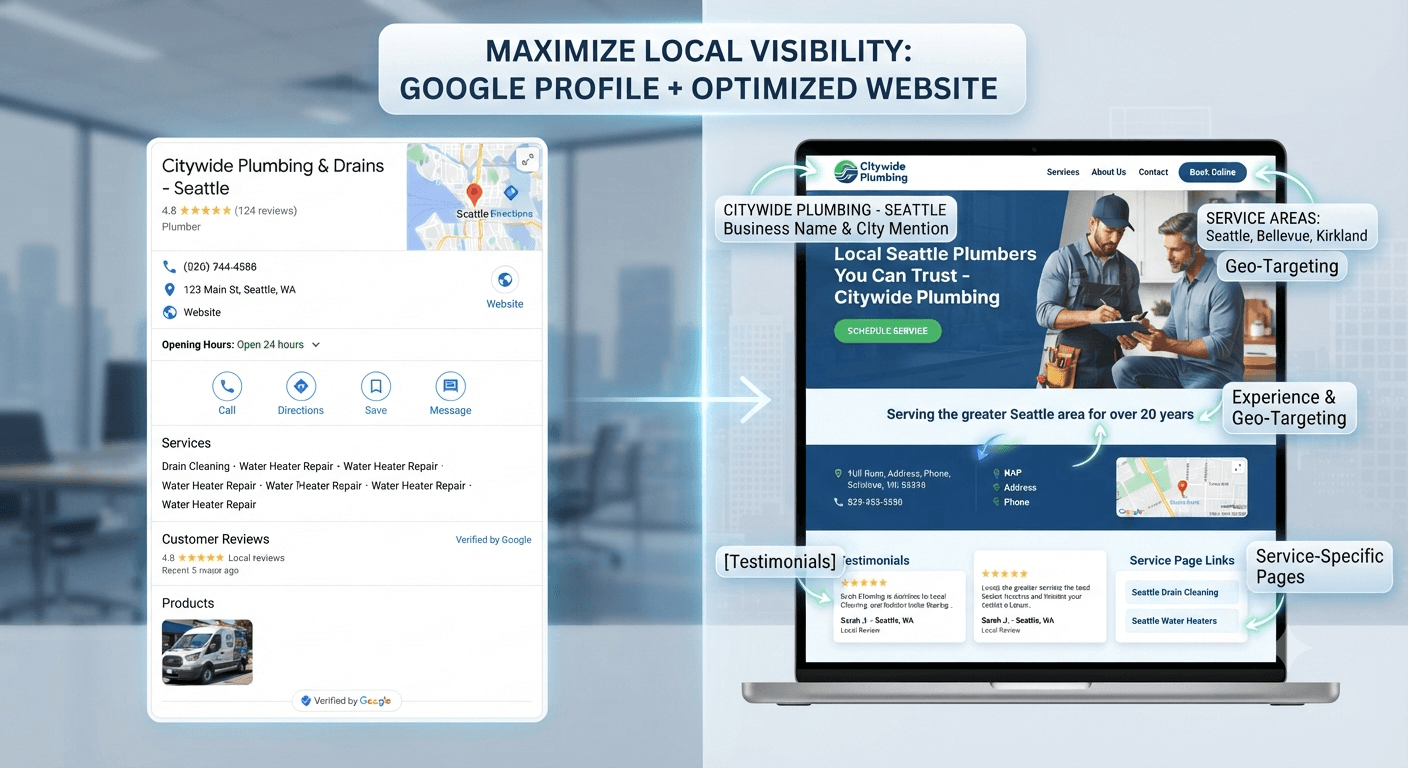
Local SEO for Calgary Small Businesses — Google Business Profile + On-Site Checklist
Most Calgary small business owners think local SEO means “get more Google reviews.” Reviews matter, but they’re one input into a system that weighs a lot more than star ratings — and I regularly see businesses spend months chasing reviews while their Google Business Profile has an unclaimed category, or their website’s address doesn’t match what’s on Maps.
This is a checklist, split deliberately into two halves: what lives on your Google Business Profile (GBP) and what lives on your website. Both matter, and neither one fixes the other’s gaps. If you’ve already read a general website checklist, this one is different on purpose — it’s specifically about the local pack (the map + three-listing block that shows up above the regular search results), not overall site health.
Table of Contents
Why the Local Pack Works Differently From Regular Search Results
When someone searches “electrician Calgary” or “physiotherapist near me,” Google usually shows a map with three business listings above the standard blue links. That block is the local pack, and it’s driven by a different (though overlapping) set of signals than normal organic ranking.
Your website still matters here — but it’s supporting evidence for the local pack decision, not the whole decision. Google is combining your Google Business Profile, your website, your reviews, and your citations (mentions of your business on other sites) into one relevance and trust score for “is this the right business to show for this search, in this location.”
Did You Know? A fully optimized website with weak or inconsistent Google Business Profile data will often lose the local pack to a competitor with a mediocre website but a clean, complete, active GBP. The two need to work together — this is the single most common mistake I see.
The Three Ranking Factors Google Actually Uses
Google has been explicit that local ranking comes down to three factors, and understanding them changes what you actually prioritize:
- Relevance — how well your business profile and website match what the searcher is looking for.
- Distance — how far your business is from the searcher (or the location they searched).
- Prominence — how well-known and well-reviewed your business is, both online and offline.
You can’t change distance. But relevance and prominence are both things a small business owner can meaningfully move — relevance through accurate categories, complete profile fields, and website content; prominence through reviews, citations, and general online presence.
Google Business Profile Checklist
This is the part most businesses under-invest in relative to how much it actually affects local pack visibility.
- Primary category is accurate and specific — “Web Designer” is more specific and often better than “Marketing Agency” if that’s genuinely your core service. Wrong or overly broad categories are one of the most common reasons a business doesn’t show for the searches it should.
- Secondary categories filled in where genuinely relevant — don’t leave this blank, but don’t stuff irrelevant categories either.
- Business description written for humans, with your services mentioned naturally — not a keyword-stuffed paragraph.
- Hours are accurate and updated for holidays — a profile showing “Open” when you’re actually closed is a fast way to lose trust with a searcher who shows up to a locked door.
- Photos are real, current, and updated regularly — Google Business Profiles with recent photo activity tend to show more engagement than static, years-old photo sets.
- Services/products list is filled in completely, not left as the default empty state.
- Q&A section is monitored — anyone can post a question on your profile, and unanswered questions sitting there for months look neglected.
- Posts are used periodically — GBP Posts (offers, updates, events) are an underused feature that signals an active, maintained profile.
- Messaging is enabled and actually responded to, if you’re using it — an enabled-but-ignored message feature does more harm than not having it at all.
Pro Tip: Claim and verify your profile directly through Google, not through a third-party “local SEO” reseller who claims it on your behalf — you want direct ownership access, not a login you have to request from someone else later.
On-Site Checklist for Local SEO
This is where your actual website comes in — it needs to reinforce, not contradict, what your GBP says.
- NAP (Name, Address, Phone) visible on every page, typically in the header or footer, matching your GBP exactly.
- A dedicated Contact page with an embedded Google Map, not just a text address.
- LocalBusiness schema markup implemented so Google can parse your business details programmatically, not just visually.
- Location or service-area content, written specifically and genuinely — not just “Calgary” repeated everywhere. (If you serve specific communities, this is where neighbourhood-specific content can reinforce local relevance further.)
- Fast mobile load times — most local searches happen on mobile, often while someone is already out and deciding where to go.
- A reviews or testimonials section, ideally pulling live from Google rather than a static, unverifiable quote block.
- Clear service pages, one per core service where it makes sense, rather than one vague “Services” page trying to rank for everything.
- Title tags and meta descriptions that include your city or service area naturally, without stuffing.
Quick Win: If you only do one thing after reading this, check that your website’s address format exactly matches your GBP listing — down to abbreviations like “St.” vs. “Street.” This single mismatch is more common, and more damaging, than most business owners realize.
NAP Consistency: The Detail Most Businesses Get Wrong
NAP stands for Name, Address, Phone — and consistency across your website, your Google Business Profile, and any directories or citations you appear in (Yelp, industry directories, chamber of commerce listings) is one of the clearest trust signals Google uses to confirm a business is legitimate and stable.
Where inconsistency commonly creeps in:
- A phone number update on your website that never gets updated on GBP or old directory listings
- Suite or unit number formatted differently across platforms
- A business name with slightly different punctuation or a dropped “Inc.” in one place
None of these individually will tank your rankings, but collectively they create the kind of ambiguity that makes Google less confident your business is what it claims to be, in the location it claims to be in.
Reviews: What Actually Moves the Needle
Reviews matter, but not in the simplistic “more is always better” way most advice suggests.
| Factor | Impact on Local Ranking |
|---|---|
| Total review count | Moderate — helps prominence, but plateaus |
| Review recency | High — a steady, ongoing stream matters more than a large batch from years ago |
| Review response rate | Moderate-High — responding to reviews (especially negative ones, professionally) signals an active, trustworthy business |
| Keyword mentions in reviews | Low-Moderate — genuine, unprompted mentions of your services in review text can reinforce relevance, but this can’t be manufactured without it reading as fake |
| Star rating alone | Lower than most people assume — a 4.6 with steady recent activity often outperforms a static 5.0 with no new reviews in a year |
Common Mistake: Buying reviews or running incentivized review campaigns that violate Google’s policies. This risks profile suspension entirely — a far worse outcome than a slower, honest accumulation of real reviews.
Common Mistakes That Quietly Kill Local Rankings
- Multiple GBP listings for the same business (often from a past address change or a well-meaning employee creating a duplicate) — this splits your reviews and signals across two profiles instead of consolidating them into one strong one.
- A “Service Area Business” set up as a storefront, or vice versa — if you don’t have a public-facing storefront, your GBP should reflect that correctly instead of showing a fake or hidden address.
- Ignoring the Q&A and messaging features and letting outdated or incorrect answers sit unaddressed.
- A website that never mentions the city or service area at all, relying entirely on GBP to carry the local signal.
- Treating this as a one-time setup task rather than an ongoing process — categories, hours, and photos need periodic review, not a single initial setup.
GBP vs. On-Site: Where to Focus First
| If your situation is… | Focus here first |
|---|---|
| GBP profile is incomplete, unclaimed, or has wrong categories | Google Business Profile |
| Website has no schema, no consistent NAP, or is slow on mobile | On-site fixes |
| Both are reasonably solid but rankings are still weak | Reviews and citation consistency |
| You’re brand new with no online presence at all | Start with GBP — it’s faster to set up correctly and has an outsized early impact |
For most established small businesses I work with in Calgary, the GBP checklist above closes gaps faster than on-site work — but the two together are what actually holds a local pack position over time.
How I Set This Up for Calgary Clients
- Audit the current GBP profile and website together — categories, NAP consistency, schema presence, and review activity, checked as one system rather than separately.
- Fix on-site technical gaps — schema markup, NAP placement, mobile speed — as part of the broader SEO service work.
- Align GBP details exactly with the website — categories, services, hours, and description.
- Set up an ongoing review response and posting cadence, so the profile stays active rather than static.
- Track local pack position for your priority terms over time, adjusting based on what’s actually moving.
If your website itself needs rebuilding to support any of this — proper schema, real NAP structure, fast mobile load — that’s core to what I build into every project; see the Calgary web development page for the full approach, or get a starting estimate.
FAQ
What’s the difference between local SEO and regular SEO? Regular SEO targets general organic rankings; local SEO specifically targets the map-based local pack and “near me” style searches, and depends heavily on your Google Business Profile in addition to your website.
Do I need a physical address to rank in the local pack? Not necessarily — service-area businesses without a public storefront can still rank, as long as the GBP profile is set up correctly as a service-area business rather than falsely showing a storefront address.
How long does it take to see local SEO results in Calgary? For lower-competition terms, movement is often visible within 60–90 days of fixing GBP and on-site gaps. Highly competitive categories in dense areas can take longer and may need ongoing review and content work.
Is my website or my Google Business Profile more important for local ranking? Neither works well without the other. GBP tends to have a faster, more direct impact on local pack visibility, but a slow or inconsistent website undermines the trust signal GBP is trying to build.
Do I need to respond to every Google review? Responding to negative reviews professionally is important for trust. Responding to positive ones isn’t mandatory, but consistent response activity overall signals an actively managed business.
Can I have more than one Google Business Profile for one business? No — duplicate listings split your review and engagement signals instead of consolidating them, and can actually suppress your ranking. Consolidate to a single verified profile.
Does my website need schema markup for local SEO? Yes — LocalBusiness schema helps Google parse your business details (name, address, hours, phone) programmatically, reinforcing what’s stated in your Google Business Profile.
What’s a citation, and do I need them? A citation is any online mention of your business’s name, address, and phone number — directories, chamber of commerce listings, industry sites. Consistent citations reinforce trust; inconsistent ones create ambiguity.
Should I use the exact same categories on GBP as the services listed on my website? They should align closely. If your GBP says “Web Designer” but your website only talks about “digital marketing,” that mismatch weakens the relevance signal instead of strengthening it.
Does posting on Google Business Profile actually help rankings? It’s a smaller factor than reviews or categories, but consistent activity (posts, photo updates, Q&A responses) signals a maintained, active business rather than an abandoned listing.
What should I fix first if I’m starting from zero? Claim and fully complete your Google Business Profile first — it’s faster to set up correctly and has an outsized early impact compared to on-site work, though both matter long-term.
Conclusion
Local SEO for a Calgary small business isn’t one task — it’s two systems that need to agree with each other: your Google Business Profile and your website. Most businesses over-invest in one (usually chasing reviews on GBP) while leaving basic on-site signals like NAP consistency and schema markup unaddressed, or vice versa.
Work through both checklists above in order, starting with whichever system currently has the bigger gaps. If your website needs the on-site half rebuilt properly — schema, NAP structure, mobile speed — that’s core to the SEO services I build into every Calgary project. Get a starting estimate, or reach out directly if you’d rather talk through your specific setup.
Written by
Sharjeel Bin Amir Founder of DevGurux · Freelance Web Developer, Calgary · WordPress Expert · AI Automation Specialist · SEO Consultant Read my full story →