
Website Redesign ROI: How Calgary Contractors Can Calculate Lead Value
As a contractor in Calgary—whether you handle home improvements, plumbing, or electrical work—you know that every dollar matters. When your current website looks outdated, it’s natural to want a refresh. But if you’re like most trades business owners, you hesitate to invest because you can’t guarantee the redesign will actually generate more quotes or calls.
You don’t want a vanity project; you want a revenue engine.
The truth is that a professional website redesign isn’t about making things look pretty—it’s about stripping away bloated code, achieving sub-second load times, and directly increasing your form submissions. By using a simple 4-step ROI formula, you can accurately predict how a clean-coded website will pay for itself.
The Problem: Why Contractors Hesitate to Redesign
Most Calgary contractors avoid redesigning their websites for two reasons: they view it as a cosmetic expense rather than a lead generation tool, and they fear unmeasurable returns.
The “Vanity Site” Misconception
Many developers sell websites based on aesthetics. But a beautiful site that takes 5 seconds to load will still lose 90% of your mobile traffic before they even see your portfolio. Business owners fear paying for a “pretty” site that doesn’t actually help them book more jobs.
Fear of Unmeasurable Returns
When a developer says, “It will help your SEO,” that feels vague. Contractors deal in concrete numbers—cost per lead, closing rates, and job margins. If you can’t put a dollar value on the traffic a new site will generate, the investment feels like a gamble.
The Solution: The 4-Step Website ROI Formula
To remove the guesswork, I use a transparent, 4-step ROI formula with my clients. This framework allows you to calculate the exact lead value a website redesign will bring to your Calgary business.
Step 1: Calculate Your Current Lead Volume
First, establish your baseline. Look at your current website analytics and CRM over the last 90 days. How many quote requests or phone calls does your site generate per month? For example, if your site brings in 10 leads a month, that is your baseline.
Step 2: Estimate Your Conversion Rate Improvement
Next, factor in the speed-to-conversion correlation. Google’s data shows that as page load times go from 1 second to 5 seconds, the probability of a mobile user bouncing increases by 90%. If your current site loads in 4 seconds and a redesign using clean HTML/CSS brings it down to 0.8 seconds, you can conservatively expect a 30% to 50% bump in lead conversion rates simply because visitors actually stay on the page long enough to fill out a form.
Step 3: Assign a Dollar Value to Each Lead
Now, do the math on your average job. If you are a Calgary renovation contractor and your average project is $10,000, and you close 1 out of every 4 leads (25% close rate), the lifetime value of a single lead is $2,500.
Step 4: Compare Investment to Return
Finally, project the 12-month return. If your redesign costs $1,500 CAD, and the speed improvements generate just 3 extra leads per month, that’s 36 new leads a year. Using the $2,500 lead value from Step 3, 36 leads represent $90,000 in potential revenue. The ROI becomes undeniable.
Real-World Example: A Calgary Contractor’s Speed Optimization
Recently, I worked with Homecraft Pro, a local Calgary home improvement contractor. Their old site was built on a bloated template. It looked passable, but it took 4.2 seconds to load on mobile networks. Mobile visitors were bouncing before the contact form even rendered.
I rebuilt their site from scratch using handwritten HTML and CSS, eliminating render-blocking scripts and compressing their project portfolio images. The new site loaded in 0.8 seconds.
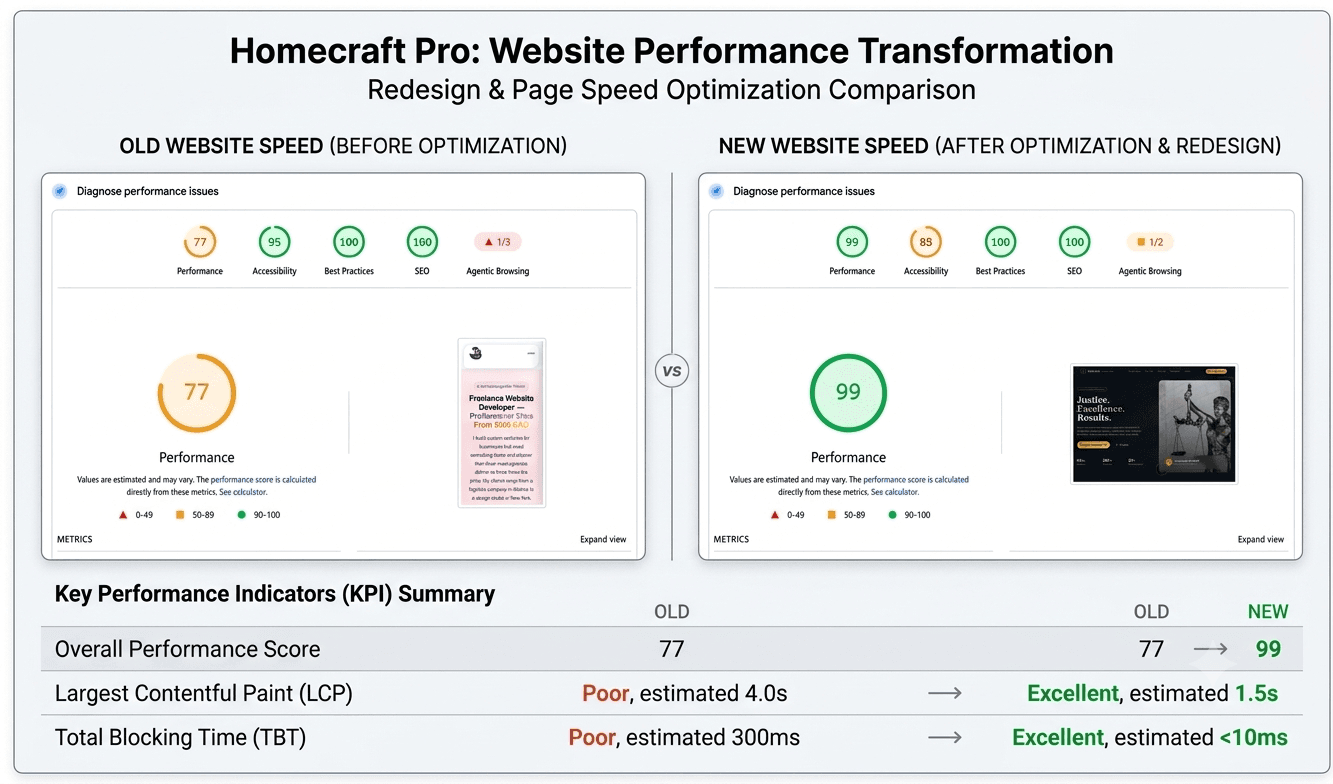
Because the site now loaded instantly on smartphones, visitors stopped bouncing. Within 60 days of launching the redesigned, clean-coded site, Homecraft Pro saw a 3.5x increase in phone calls and quote form submissions.
Slow Site vs. Fast Site: 12-Month Lead Projection
To visualize the ROI, look at the difference between a slow, template-heavy site and a fast, custom-coded site over a 12-month period:
| Metric | Slow Site (4.0s+ Load Time) | Fast Site (Sub-1.0s Load Time) |
|---|---|---|
| Monthly Traffic | 500 visitors | 500 visitors |
| Bounce Rate | 65% (visitors leave immediately) | 20% (visitors stay to browse) |
| Lead Conversion Rate | 1.5% (7 leads/month) | 5.0% (25 leads/month) |
| Total Annual Leads | 84 Leads | 300 Leads |
| Est. Revenue (at $5k/job) | $420,000 | $1,500,000 |
(Learn more about how page load time directly impacts bounce rates and conversions via Google’s Web Vitals research.)
What to Do Next
A website redesign should never be a blind investment. If your site is suffering from slow load times, my professional website redesign services focus specifically on conversion, stripping away bloat to achieve the sub-second speeds that turn visitors into paying clients.
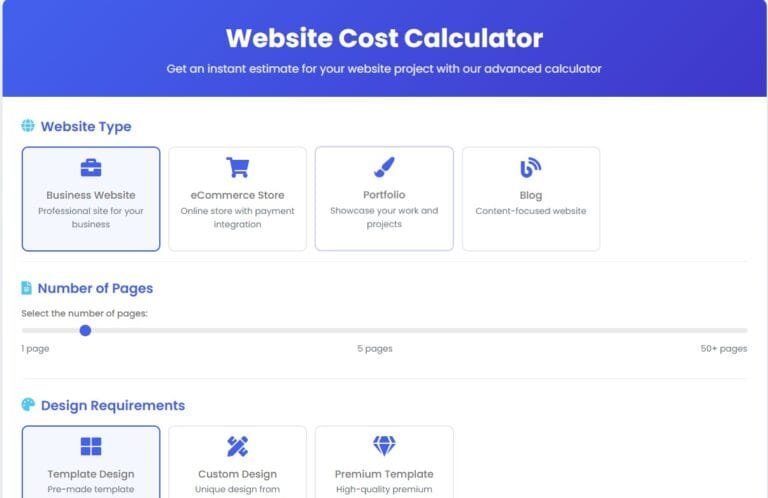
Want proof that clean code beats bloated templates? See the exact results of this approach in my Homecraft Pro contractor case study, and see how fast your current site is by running it through my free website cost calculator to see what a performance-driven rebuild would cost.
Frequently Asked Questions
How much does a contractor website redesign cost in Calgary?
A professional, custom-coded contractor website typically starts around $600 CAD for a foundational 5-page site, scaling up to $1,500 – $2,500 CAD depending on custom quote forms, portfolio galleries, and CRM integrations.
How long does a website redesign take?
For a local contractor, a complete redesign—from wireframing to speed testing and launch—usually takes 3 to 7 business days, provided the copy and project images are ready.
Will a faster website actually get me more jobs?
Yes. Mobile users searching for local contractors expect instant information. If your site loads in under 1 second, visitors are exponentially more likely to stay on the page, read your reviews, and fill out your quote form, directly increasing your booked jobs.